Favorite 2000s Albums: #4 – Sleater-Kinney – “One Beat”

Listen on Spotify

No event shaped American life in the last decade like 9/11. I still vividly remember hearing about it when I was a sixth grader, and I also remember that awkward period after 9/11 where nobody knew exactly what was going to happen in America. For artists, 9/11 created a separate conundrum: what could be said about such an unthinkable tragedy? Most understandably opted to avoid the whole mess rather than risk alienating fans or being seen as making light of the event.

Not Sleater-Kinney. Following their 2000 album All Hands on the Bad One, banshee-voiced singer Corin Tucker gave birth to her first child. After a pair of more introspective albums, that event and 9/11 shape the music on One Beat, which effortlessly combines the political and the personal while also rocking to the stratosphere with a thrilling vitality.

Politics had always been part of Sleater-Kinney’s MO, but on One Beat they really come to the forefront. That resulted in some expected criticism of the band, but it’s also what makes One Beat feel so essential. Recorded in March and released in August 2002, the band takes prophetic shots at the Bush administration before it became a cliche for bands to do so. The band also plays as a unit more than they ever had before, with Carrie Brownstein providing monster riffs and more vocals while Janet Weiss continues to wail on her drums. Tucker’s voice, always the breaking point when it comes to people trying to get into S-K, is as unhinged and emotional as ever.

“Far Away” is one of the defining songs on One Beat, combining a thunderous guitar riff with Tucker’s first-hand account of seeing 9/11 on TV while she’s nursing her baby. That’s followed by the first overtly political statement of the album: “don’t breathe the air today/don’t speak of why you’re afraid,” presenting Sleater-Kinney as the band that would speak up in the awkward silence that was post 9/11 life. Later, they take their first pointed shot at Bush: “the president hides while working men rush in and give their lives.”

“Step Aside” takes a different approach, putting the polemics into a danceable song with call and response vocals. “Why don’t you shake a tail for peace and love?” Tucker asks on the song, and it seems to capture Sleater-Kinney’s worldview of music being a tool for change and fun. “Combat Rock” features most of the album’s most cutting lines (and its most memorable guitar riff), with Brownstein hiccuping through the verses and the band once again taking aim at the uncomfortable silence that followed 9/11 and preceded the Iraq war: “Where is the questioning? Where is our protest song? Since when is skepticism un-American?” Album closer “Sympathy” provides almost too much emotional catharsis, with Tucker praying for the life of her son (who was born premature).

One Beat stands up as Sleater-Kinney’s most diverse album, with many different sounds and moods. For every serious Bush-bashing song on the album there’s also one that’s a lot of fun, be it the tongue-in-cheek tale of the good girl gone bad in “Prisstina” or the poppy “Oh!” with its wah-wah chorus. But it’s the political moments that get the most attention, and for good reason: while other bands would follow in their path and perhaps dull One Beat‘s impact, it’s an album that took a lot of courage to make. In a time where almost everyone else was being quiet, Sleater-Kinney spoke up, and that’s what makes One Beat a rock album of incredible power and purpose.

Nearly ten years removed from One Beat, its shots at republicans, anti-intellectualism, and consumerism still feel depressingly relevant. What also feels relevant about the album is that it’s a reminder of what rock music can be: One Beat feels like an album that had to be made and heard. I debate endlessly about what my favorite Sleater-Kinney album is, but One Beat is probably the one that I respect the most, because it’s so fearless and strong in its convictions.
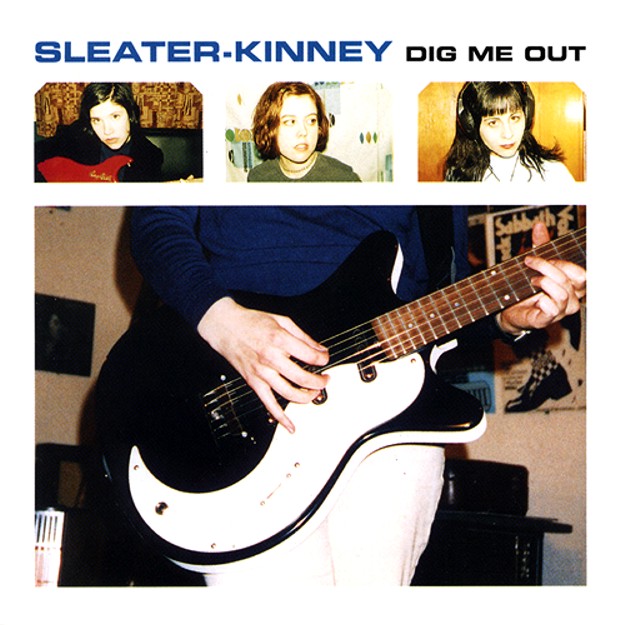

Favorite 90s Albums: #3 – Sleater-Kinney – “Dig Me Out”

At this point, I’m sure people are aware of my deep, abiding love of Sleater-Kinney.  They’re my musical religion, the band that, to me, represents everything that music should be about. All of the elements that make them a definitive rock band to me are present on their 1997 album Dig Me Out, which many fans would argue is their high point as a group.

Admittedly, I’m a big dork about rock music.  For me, it isn’t for blasting in the radio or playing at a party.  Rather, I like to take the term literally:  It should “rock” you, make you think, and wake you up from the constant doldrums of life and humanity.  Alleged “rock” bands that don’t do these things are frequently the target of my ire and it’s a constant disagreement I have with other people.

Dig Me Out is one of my all-time favorite rock albums because it has such a sense of purpose.  It isn’t just trying to sound cool or to be a fun soundtrack to a dance party (although some of the songs are quite danceable).  It wants to jolt the listener, to move them and inspire them.  And for a certain group of people, the types that are disenfranchised with the status quo in both the real world and music world, it does just that, which might explain why the band has such a rabid (but relatively small) following.

For Dig Me Out, Sleater-Kinney brought in a new drummer, Janet Weiss, to go along with Corin Tucker and Carrie Brownstein’s two-pronged guitar and vocals assault.  Weiss immediately gave the band a new-found sense of confidence and swagger, and as a result Dig Me Out sounds like their first album in which they’re aspiring to be a great all-around rock band rather than just a punk outfit.  Her presence was immediately felt in the opening title track, which I consider one of the band’s signature songs.

After the release of their 2000 album “All Hands on the Bad One”, music critic Robert Christgau said of the band: “locked into a visceral style and sound that always maximizes their considerable and highly specific gifts, they could no more make a bad album than the Rolling Stones in 1967.”  It’s a bold statement, but one I find completely true:  Not only can I not imagine Sleater-Kinney making a bad album, it’s hard for me to picture them making a bad song.  Corin Tucker’s attention-demanding vocals, Brownstein’s complex riffwork and vocal chemistry with Tucker along with Weiss’s drumming made Sleater-Kinney into a machine.  It’s apparent on Dig Me Out, which comes storming out of the gate with three of the band’s best songs and never lets up from there, providing an exhilarating 36 minutes of rock and roll.

The oddball song on the album is “One More Hour,” a more personal song that (apparently) details the break-up between Tucker and Brownstein that happened in the early days of the band.  Sleater-Kinney’s style makes the song work perfectly, as the ping-ponging guitars and vocals also play into the idea of the two having had a relationship.  I think it’s one of the all-time great indie break-up songs and it foreshadows the shift Sleater-Kinney would make on their next album (“The Hot Rock”) into more personal territory instead of rousing, occasionally feminist anthems.

I’ve always thought that all-female bands occupied a strange place in music, which might be why I’m so fascinated by them.  The female listeners they’re often trying to inspire often just listen to sensitive guys strumming on guitar, while a lot of male listeners look up to male rock idols in order to seem “manly.”  The band seemed to channel a lot of those concepts into meta songs about being in a band, like the infectious “Words and Guitar.”

The band’s greatness has eventually caused me to dub something called “The Sleater-Kinney Effect”, based on how lame the band is able to make other artists (especially their male counterparts) sound after listening to them.  The effect becomes even more pronounced through time, as 90’s guitar rock went by the wayside and Sleater-Kinney towered over unoriginal post-punk bands and wimpy indie pop in the first half of the 2000s.  In 1997 things probably felt the same way, as Dig Me Out provided a jolt of legitimate female empowerment at the height of the Spice Girls “girl power” movement, and surely inspired many women (including one of my favorite current artists, Marnie Stern) to pick up a guitar.

Despite how convinced I am that they’re one of the best bands ever, I’ve come to accept that Sleater-Kinney is a love-it or hate-it proposition.  Tucker’s vocals are difficult on the ears a lot of listeners and a lot of people are put off by the band’s apparent feminist sloganeering.  At the same time, the idea of listening to Dig Me Out and not being inspired by the passion put into each song is foreign to me, even as a guy who isn’t really the target audience.  More than any other band, I feel like people that love Sleater-Kinney “get it” on a level beyond typical music listeners.

Wild Flag

If you’ve been reading this blog from the beginning (which I can only hope you have been, for continuity reasons), you may have noticed that there’s been a distinct lack of actual new music on it.  This is sort of intentional:  While I’ve actually liked 2011 quite a bit and have been making a conscious effort to listen to a lot of new stuff, I still think that something has been missing from current music.  I’ve grown a bit jaded about how most of the hyped bands of the day all seem to chart the same influences, to be following the same basic formula, and constantly living in the past.

Enter Wild Flag, a four woman supergroup consisting of singer/guitarist Carrie Brownstein and drummer Janet Weiss from Sleater-Kinney, Mary Timony from Helium and a solo career, and Rebecca Cole of the Minders.  Those names probably don’t mean a whole lot to many people reading this, but for me and many others its a dream collaboration, a veritable Traveling Wilburys of indie rock goddesses.  From day one, the band has had a massive amount of hype and expectations from rabid Sleater-Kinney fans, the kind like me who think rock music has been circling the drain since the band went on indefinite hiatus in 2006 following their colossal swan song, “The Woods.”

The expectations for Wild Flag are expected, but also unfair.  In reality, there’s no way the band could capture the unique chemistry and passion that defined Sleater-Kinney.  However, their debut album, which is streaming on NPR, is nonetheless an immensely satisfying collection of tunes that fills many of the gaps left empty by today’s indie kids.

See, Wild Flag make rock music.  Not “indie” rock or “noise” rock or whatever other lame qualifiers people seem to put in front of it now.  This is fun, energetic rock music that is never boring, and in today’s musical climate that qualifies as a revelation.  It doesn’t have the urgency of Sleater-Kinney or the dark combativeness of Helium; rather, it’s a pure, unpretentious showcase of everything that rock can offer from four women who know a lot about it.

A common knock on supergroups is that they’re more a collection of individuals than a cohesive band.  Wild Flag defies that, as they’re instantly able to craft a unique sound that separates themselves from their previous bands.  It’s a diverse collection of songs, from the almost power pop lead track and first single “Romance” to the woozy psychedelia of “Glass Tambourine”.  Brownstein and Timony mostly trade vocals and harmonies, and each brings a different energy to each song.

While the hype around Wild Flag has mostly surrounded the Sleater-Kinney semi-reunion, it’s actually Timony who may be the band’s MVP.  In the later days of Helium and the beginnings of her solo career, Timony flirted with being sort of an indie fantasy pixie girl, as she sang about magic and dragons and played quirky songs full of lush instrumentation.  She doesn’t do that on Wild Flag (although she does sneak a “dragonslayer” reference into “Electric Band”), but her more laid back, mystical qualities make a nice foil for Brownstein’s hyperactive wildness.  It’s illustrated on album closer “Black Tiles”, my favorite song so far, and the only one where they exchange lead vocals and put that duality on full display.  Both are also tremendously gifted guitar players and are able to rip a lot of memorable riffs and solos in each song.

Of course, Wild Flag is also anchored by Weiss, who continues to prove that she’s arguably the best rock drummer in music today.  I know absolutely nothing about drumming, but I can still tell that Weiss is really, really good at it, and she brings a ton of life to each song with her thunderous playing.  Rebecca Cole (who I’m mostly unfamiliar with) also gives the songs some extra bounce with her keyboards, which add an extra dimension that the group’s previous bands didn’t have.

In the end, Wild Flag meets their lofty expectations and provides an absolute treat for Sleater-Kinney fans like me that were too busy failing at life to get into them before they went on hiatus.  But beyond that, it’s possibly the most refreshing album of the year so far — a much needed shot of energy and life into the increasingly dull music landscape.