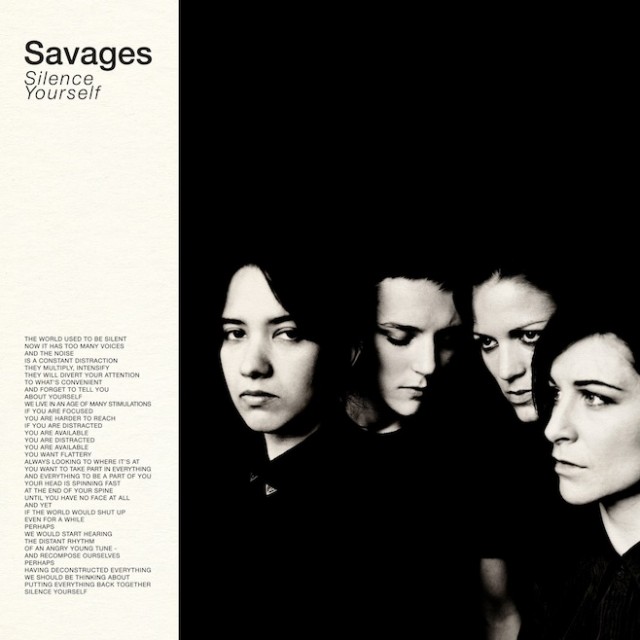
The world used to be silent. Now it has too many voices, and the noise is a constant distraction. They multiply, intensify; they will divert your attention to what’s convenient and forget to tell you about yourself. We live in an age of many stimulations. If you are focused, you are harder to reach. If you are distracted, you are available. You are distracted; you are available. You want flattery. Always looking to where it’s at, you want to take part in everything and everything to be a part of you. Your head is spinning fast at the end of your spine until you have no face at all. And yet, if the world would shut up, even for awhile, perhaps we would start hearing the distant rhythm of an angry young tune, and recompose ourselves. Perhaps, having deconstructed everything, we should be thinking about putting everything back together. Silence yourself.
So goes the manifesto of Savages, a foursome of singer Jehnny Beth, guitarist Gemma Thompson, bassist Ayse Hassan, and drummer Fay Milton that wants to return the world to a simpler time. Everything the band does zeroes in on this back-to-basics, somewhat Luddite aesthetic: the album’s cover is a simple, black-and-white photo of the group and their songs are stark, noisy and rhythmic in a way that recalls many early post-punk bands like Joy Division, Siouxsie and the Banshees, or a less funky Bush Tetras. At shows, they urge audiences to turn off their cell phones and cameras so they can FEEL THE MUSIC.
If you haven’t figured it out yet, Savages are a band that take themselves very seriously, and everything they do is calculated to provoke a response. They have positioned themselves as the elixir for all of rock music’s problems, the band that will restore music to its former glory before Twitter and Facebook and blogs like this one ruined it forever. Silence Yourself is the sound of a band that is very eager — one could say desperate — to “matter,” and it demands your attention.
A lot of this reads like criticism, and in some ways it is. Their style catches the eye and created a lot of hype, which obviously led to a backlash that isn’t entirely undeserved — it’s not difficult to picture people being annoyed by Savages and the persona they’ve built in the media for the last year. But I don’t necessarily have a problem with a band taking music seriously, and think there’s even something admirable about a group that seeks to drive a message into the brains of their listeners. It’s part of why I like Riot Grrrl and a lot of other punk music, and it’s part of why I largely enjoy Silence Yourself despite some of its flaws and the way it sometimes begs cynical guys like me to mock it.
Ranty manifestos aside, Silence Yourself is impressive because of how fully realized it is as a debut album. Whether you agree with what Savages have to say about the world or not, they’re a band that has a clear point-of-view, which they communicate effectively through music that is muscular and confident. The songs also have an urgency that is largely missing from rock music today: “Husbands,” which was released as a single last year and appears in a slightly revised form on the album, reaches the album’s highest intensity levels with its rolling bass and Beth’s increasingly frantic vocal. “She Will” begins with an immediate guitar riff, then explodes into a dissonant, primal chorus, with Beth repeatedly shrieking the title.
The band’s sound is deeply indebted to the 80s, but their lyrics about current hot topics like women’s issues and modern technology help make them more than just a backwards-looking nostalgia act. Silence Yourself does have a couple of lulls, notably when the band inevitably attempts slower “mood” pieces like “Marshal Dear” and the instrumental “Dead Nature” that I think get away from their strengths, which are being loud and strident. Fortunately, there’s enough of those moments to make Silence Yourself one of the stronger releases of the year, and one that is worth listening to for people that are a bit bored by rock’s status quo. You can buy it from their website, http://savagesband.com.
 The biggest challenge of writing about music is trying to describe why I like what I like. With some artists, it’s not too hard, because something about their music or personality lends itself to narrative, or they played a role in my life that makes for a decent story. Others are more difficult — the music might just sound the way I like music to sound, in which case there isn’t a whole lot to say other than “This is really good, in my opinion. Maybe you will like it too.” These bands may not make for the most interesting blog posts, but they are a large part of my music collection, and really define my taste more than the bigger name artists.
 The Noise Made By People