Heavy Feelings Bring the Edge Back to Rock Music

The voice I heard on this somewhat anonymous EP felt familiar. It turns out it’s Nadia Garofalo, formerly of Ganser, which makes all the sense in the world because their last album, Just Look at That Sky, was one of the best rock releases of the last few years. This collaboration between Garofalo and Ben Shillabeer crosses the Atlantic (Garofalo lives in Chicago while Shillabeer lives in the UK) and is in a similar mold of post-punk sounds combined with lyrics that are so sharp that they practically draw blood.

Punk is in a tough spot lately because it is hard to really come off as provocative. Bashing Republicans is thuddingly obvious, and the left has so much tone-policing that a lot of artists shriek their lyrics but ultimately still come off as docile rule-followers. Heavy Feelings has the right idea, as the lyrics turn inward and often reveal uncomfortable truths about ourselves, and the spiky sound is chaotic without becoming completely formless.

The opener, “Noctalgia,” is the catchiest of the four songs, with a crunchy guitar riff and lyrics that go back to the Ganser theme of looking at the sky. It touches on a recurring theme across the EP, which is how our brains have melted due to a combination of internal and external factors. “Bootlickers” is more of a lashing out, with Garofalo tearing into suck-ups and parasites with cutting words: “how do you sleep so sound when the sky is falling and your neck’s in the ground?” My favorite of these tracks is probably “Pacemaker,” which goes in a more internal, atmospheric direction with haunting synths and a nearly spoken word vocal that hits close to home. “Nothing hits harder than steps not taken,” and “they worry so much about violence, but it’s the monotony that will kill you” are the sort of harsh-but-real lines that give this EP a legitimate edge. The rumbling “Goodfaith” closes things out, and I interpret it as being about how everyone shouts past each other now and how frustrating it is to try to have any kind of intellectual debate anymore. “What’s the use when everything is true?” sums up most of the discourse now where people create their own individual realities and have built up walls against any criticism or debate.

The hard-hitting lyrics and the aggressive sound give Heavy Feelings some actual abrasiveness — it has the provocative nature of punk in terms of probing and asking questions without the annoying performative aspect. This duo has channeled a lot of frustration and angst into an EP that packs more of a punch than almost any recent full-length release.
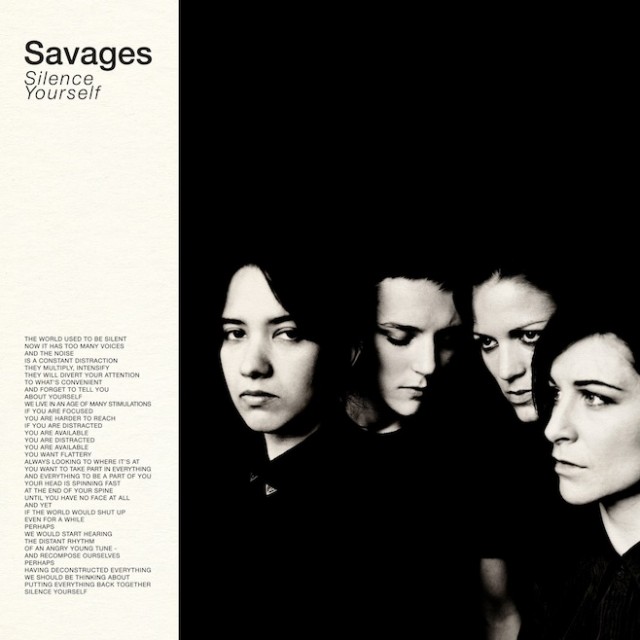
Savages – “Silence Yourself”

Savages

The world used to be silent. Now it has too many voices, and the noise is a constant distraction. They multiply, intensify; they will divert your attention to what’s convenient and forget to tell you about yourself. We live in an age of many stimulations. If you are focused, you are harder to reach.  If you are distracted, you are available. You are distracted; you are available. You want flattery. Always looking to where it’s at, you want to take part in everything and everything to be a part of you. Your head is spinning fast at the end of your spine until you have no face at all. And yet, if the world would shut up, even for awhile, perhaps we would start hearing the distant rhythm of an angry young tune, and recompose ourselves. Perhaps, having deconstructed everything, we should be thinking about putting everything back together. Silence yourself.

So goes the manifesto of Savages, a foursome of singer Jehnny Beth, guitarist Gemma Thompson, bassist Ayse Hassan, and drummer Fay Milton that wants to return the world to a simpler time. Everything the band does zeroes in on this back-to-basics, somewhat Luddite aesthetic: the album’s cover is a simple, black-and-white photo of the group and their songs are stark, noisy and rhythmic in a way that recalls many early post-punk bands like Joy Division, Siouxsie and the Banshees, or a less funky Bush Tetras. At shows, they urge audiences to turn off their cell phones and cameras so they can FEEL THE MUSIC.

If you haven’t figured it out yet, Savages are a band that take themselves very seriously, and everything they do is calculated to provoke a response. They have positioned themselves as the elixir for all of rock music’s problems, the band that will restore music to its former glory before Twitter and Facebook and blogs like this one ruined it forever. Silence Yourself is the sound of a band that is very eager — one could say desperate — to “matter,” and it demands your attention.

A lot of this reads like criticism, and in some ways it is. Their style catches the eye and created a lot of hype, which obviously led to a backlash that isn’t entirely undeserved — it’s not difficult to picture people being annoyed by Savages and the persona they’ve built in the media for the last year. But I don’t necessarily have a problem with a band taking music seriously, and think there’s even something admirable about a group that seeks to drive a message into the brains of their listeners. It’s part of why I like Riot Grrrl and a lot of other punk music, and it’s part of why I largely enjoy Silence Yourself despite some of its flaws and the way it sometimes begs cynical guys like me to mock it.

Ranty manifestos aside, Silence Yourself is impressive because of how fully realized it is as a debut album. Whether you agree with what Savages have to say about the world or not, they’re a band that has a clear point-of-view, which they communicate effectively through music that is muscular and confident. The songs also have an urgency that is largely missing from rock music today: “Husbands,” which was released as a single last year and appears in a slightly revised form on the album, reaches the album’s highest intensity levels with its rolling bass and Beth’s increasingly frantic vocal. “She Will” begins with an immediate guitar riff, then explodes into a dissonant, primal chorus, with Beth repeatedly shrieking the title.

The band’s sound is deeply indebted to the 80s, but their lyrics about current hot topics like women’s issues and modern technology help make them more than just a backwards-looking nostalgia act. Silence Yourself does have a couple of lulls, notably when the band inevitably attempts slower “mood” pieces like “Marshal Dear” and the instrumental “Dead Nature” that I think get away from their strengths, which are being loud and strident. Fortunately, there’s enough of those moments to make Silence Yourself one of the stronger releases of the year, and one that is worth listening to for people that are a bit bored by rock’s status quo. You can buy it from their website, http://savagesband.com.

No Joy – “Wait to Pleasure”

The biggest challenge of writing about music is trying to describe why I like what I like. With some artists, it’s not too hard, because something about their music or personality lends itself to narrative, or they played a role in my life that makes for a decent story. Others are more difficult — the music might just sound the way I like music to sound, in which case there isn’t a whole lot to say other than “This is really good, in my opinion. Maybe you will like it too.” These bands may not make for the most interesting blog posts, but they are a large part of my music collection, and really define my taste more than the bigger name artists.

No Joy is one of those tricky bands. Built on the songwriting duo of Laura Lloyd and Jasamine White-Glutz, they play music that basically has everything I like: very loud shoegaze guitars that unleash sheets of noise, melodic songwriting and (of course) female vocals. Wait to Pleasure is their second full length, following 2010’s vastly underrated Ghost Blonde and last year’s Negaverse E.P, and it represents a huge leap forward for the band, who have now developed their own identity while continuing to refine their songwriting. It’s not an album that will have any sort of broader narrative attached to it, but fans of the band and this genre will almost certainly be very pleased.

No Joy separate themselves from the horde of bands mining similar influences by doing everything just a bit better: the guitars are louder, the melodies are catchier, and the production is cleaner. This is a band that understands what makes shoegaze great and why people listen to it. Songs like “Hare Tarot Lies” sum up their strengths well, combining noisy riffs and hooks, which with their indecipherable lyrics make the song accessible and mysterious at the same time. “Lunar Phobia” sounds different from any song on Ghost Blonde, with more emphasis on keyboards and a programmed drum beat that helps the band step out of the shadow of their influences a bit.

It can be easy to write off a band like No Joy as an imitator of earlier groups that have explored similar territory, but Wait for Pleasure is an album that actually doesn’t sound like much else — it has a pop sensibility that some other shoegaze groups lack, and the decibel levels separate it from lighter noise-pop bands like Best Coast. It’s basically non-stop jams, and I recommend it a lot to anyone with an interest in loud guitar rock. You can buy it from their label, Mexican Summer, here.