If you’ve been reading this blog from the beginning (which I can only hope you have been, for continuity reasons), you may have noticed that there’s been a distinct lack of actual new music on it. This is sort of intentional: While I’ve actually liked 2011 quite a bit and have been making a conscious effort to listen to a lot of new stuff, I still think that something has been missing from current music. I’ve grown a bit jaded about how most of the hyped bands of the day all seem to chart the same influences, to be following the same basic formula, and constantly living in the past.
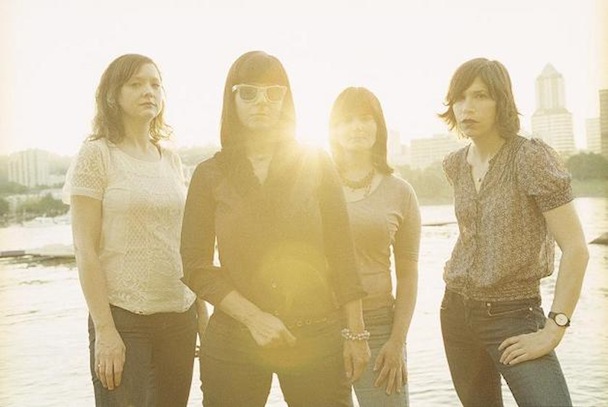
Enter Wild Flag, a four woman supergroup consisting of singer/guitarist Carrie Brownstein and drummer Janet Weiss from Sleater-Kinney, Mary Timony from Helium and a solo career, and Rebecca Cole of the Minders. Those names probably don’t mean a whole lot to many people reading this, but for me and many others its a dream collaboration, a veritable Traveling Wilburys of indie rock goddesses. From day one, the band has had a massive amount of hype and expectations from rabid Sleater-Kinney fans, the kind like me who think rock music has been circling the drain since the band went on indefinite hiatus in 2006 following their colossal swan song, “The Woods.”
The expectations for Wild Flag are expected, but also unfair. In reality, there’s no way the band could capture the unique chemistry and passion that defined Sleater-Kinney. However, their debut album, which is streaming on NPR, is nonetheless an immensely satisfying collection of tunes that fills many of the gaps left empty by today’s indie kids.
See, Wild Flag make rock music. Not “indie” rock or “noise” rock or whatever other lame qualifiers people seem to put in front of it now. This is fun, energetic rock music that is never boring, and in today’s musical climate that qualifies as a revelation. It doesn’t have the urgency of Sleater-Kinney or the dark combativeness of Helium; rather, it’s a pure, unpretentious showcase of everything that rock can offer from four women who know a lot about it.
A common knock on supergroups is that they’re more a collection of individuals than a cohesive band. Wild Flag defies that, as they’re instantly able to craft a unique sound that separates themselves from their previous bands. It’s a diverse collection of songs, from the almost power pop lead track and first single “Romance” to the woozy psychedelia of “Glass Tambourine”. Brownstein and Timony mostly trade vocals and harmonies, and each brings a different energy to each song.
While the hype around Wild Flag has mostly surrounded the Sleater-Kinney semi-reunion, it’s actually Timony who may be the band’s MVP. In the later days of Helium and the beginnings of her solo career, Timony flirted with being sort of an indie fantasy pixie girl, as she sang about magic and dragons and played quirky songs full of lush instrumentation. She doesn’t do that on Wild Flag (although she does sneak a “dragonslayer” reference into “Electric Band”), but her more laid back, mystical qualities make a nice foil for Brownstein’s hyperactive wildness. It’s illustrated on album closer “Black Tiles”, my favorite song so far, and the only one where they exchange lead vocals and put that duality on full display. Both are also tremendously gifted guitar players and are able to rip a lot of memorable riffs and solos in each song.
Of course, Wild Flag is also anchored by Weiss, who continues to prove that she’s arguably the best rock drummer in music today. I know absolutely nothing about drumming, but I can still tell that Weiss is really, really good at it, and she brings a ton of life to each song with her thunderous playing. Rebecca Cole (who I’m mostly unfamiliar with) also gives the songs some extra bounce with her keyboards, which add an extra dimension that the group’s previous bands didn’t have.
In the end, Wild Flag meets their lofty expectations and provides an absolute treat for Sleater-Kinney fans like me that were too busy failing at life to get into them before they went on hiatus. But beyond that, it’s possibly the most refreshing album of the year so far — a much needed shot of energy and life into the increasingly dull music landscape.
Listening to Life Without Buildings for the first time was a thoroughly confusing experience. On first listen, the band’s songs were hard to differentiate from one another and seemed like they were all over the place. I also thought the singer might be mentally challenged and had no clue what she was babbling about. Despite that, I was intrigued, so I made a mental note to revisit the band later.
So Life Without Buildings sat on my iPod, metaphorically gathering dust. Occasionally I would scroll past them and try to remember who they were, then tell myself “oh yeah, the band with the weirdo singer” before I moved on to whatever I was going to listen to. Then one day, I made a Facebook post about how I couldn’t get into Joanna Newsom despite my love of weirdo indie females, which reminded me of another weirdo indie female that I had forgotten about.
That weirdo singer was Sue Tompkins, a painter and sound artist from Glasgow who fronted Life Without Buildings. Tompkins’ distinctive talk-sung vocals were the calling card of the band. She took the ideas from her sound art and applied the to the music, basing songs around repetitive phrasing, random exclamations, and sometimes what appeared to be just plain gibberish. In a typical Life Without Buildings song, she’ll talk-sing non-stop, jabbering and stuttering weird phrases, squealing with childish glee, and in general sounding a little bit like a toddler.
On the second listen to their lone album Any Other City, I was suddenly obsessed. By about the fifth, I wanted to be Sue Tompkins’ best friend. It’s now one of my favorite albums ever and I don’t think I’ve been so obsessed with a band since I got into Sleater-Kinney. But, while I have an easy time explaining why Sleater-Kinney is so great, I find it a bit more difficult to articulate the brilliance of Life Without Buildings.
I think Life Without Buildings is one of the few bands that just has a magical aura about them, and it’s mostly due to Tompkins. While indebted to previous talk-singers like The Fall’s Mark E. Smith and various female post-punkers, she has a vocal style that is unlike anything else in music due to her lyrics. While it would be easy to write off those lyrics as the improvised workings of a crackpot, I’m convinced that there’s a deeper meaning to them. I’m just not sure what yet, and that’s part of the band’s allure: Every song is like a riddle that is impossible to fully crack.
Perhaps the genius of the band fully set in when I listened to their live album Live at the Annandale Hotel. While I’m typically not a fan of live albums, this one is an essential recording of a rare performance from a short-lived band, and features Tompkins’ adorable stage banter and breathless enthusiasm. Most shockingly of all, the live versions of the songs are near carbon copies of the ones on record, proving that there’s a real method behind Tompkins’ madness.
Lost in all this blathering about Tompkins is that the band behind her was extremely good as well. Led by Robert Johnston’s melodic guitar playing, they’re the perfect complement to Tompkins’ ramshackle vocals. Rather than be flashy and show everyone how great they are at playing their instruments, they’re willing to take a backseat and complement Tompkins with strong rhythmic playing.
As mentioned, LWB only made one album, Any Other City. Along with a couple songs off singles, they have 14 songs in total (along with the accompanying live versions from Live at the Annandale Hotel). I’ve been playing the crap out of all of them, treasuring every second that the band recorded and constantly wishing there was more. Unfortunately, the band broke up, partly because Tompkins wanted to go back to pursuing her art.
While their scant amount of material is disappointing, it’s acceptable when the quality of everything is so high. The band mostly had one trick anyways, so it’s hard to know what they would have done after Any Other City. On that album, they use pretty much every variation of that trick perfectly, delivering a set of songs that are more different from each other than they appear on first listen. The first track is “PS Exclusive”, the fastest paced and most rocking song on the album which immediately asserts the genius of Tompkins, who cycles through phrases like “the right stuff” and “this is not advice” until they’re burrowed into your brain.
More than any other band, there are specific little moments in each LWB song that I absolutely love, and it’s easy to collect a list of favorite phrases from the eminently quotable Tompkins. “Let’s Get Out” has some of her best lines, including “LOOK AROUUNDDDDD”, “look back and say that I didn’t!” and “come complete!” The spiky instrumentation makes it possibly the most post-punk track on the album, but Tompkins’ vocals always separate LWB from the post-punk revival bands that would follow them (usually gloomy Joy Divison knockoffs).
While I love all of their songs, “The Leanover” stands out among them and is, in my opinion, one of the best songs of the last decade. It’s wordy even for LWB standards, and I love reading different interpretations of the song (one rumor is that it’s about fellatio; I prefer to think of it as being about the beginnings of a relationship in general). It’s littered with pop culture references (M-B-V would seem to be a nod to My Bloody Valentine, Virginia Plain, etc) and more Tompkins-isms like “I don’t trade”, “contact!”, and “he’s the shaker, baby!” The rest of the band gives it a perfect background with a more laid back, dreamy sound.
There’s numerous other highlights on the album: The mostly spoken-word finale “Sorrow”, the jaggedy pop of “14 Days”, “Juno” with its tempo changes and ringing guitars. I think every song is worth checking out, although the band is obviously an acquired taste: What makes Tompkins such a genius is also what likely drives a lot of people away from the band. Regardless, in a decade that I thought was marked by a lot of boring and unoriginal music, Life Without Buildings stood out as a unique band that had more charisma and personality than any of their peers.
Insulting an ex-boyfriend has long been a tradition in girl rock, but I’m not sure if any ex has been eviscerated quite as soundly as the poor bastard that got “Stutter” written about him. In a sense, that poor bastard is every male rock star who has sung about his sex appeal or getting laid: “Stutter” isn’t just a roaring, catchy britpop/punk song, but a perfectly executed take-down of masculine bro culture. Singer Justine Frischmann brings a somewhat detached sexuality to the song, even though it’s about erectile dysfunction (a topic that I can’t imagine many male singers have tackled). “Is there something you lack/when I’m flat on my back/is there something I can do for you?” she sneers in the chorus, followed by the final zinger: “Is it just that I’m much too much for you?” Ouch.
9. The Slits – “Typical Girls” (1979)
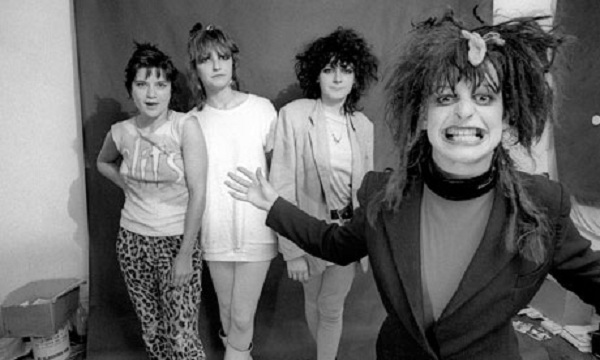
The Slits were one of the weirdest bands in rock music history: One of the earliest female punk bands, their lead singer was a teenager with a wild, Medusa-like head of hair. They also had a growing love of African rhythms, which manifested itself on their 1979 album “Cut”, a bizarre combination of girl punk and reggae fronted by Ari Up’s quivering voice. Like most of their songs, “Typical Girls” is strange and unpredictable, veering wildly between a twinkling piano part and the reggae-influenced post-punk of the rest of the album. During all this sonic weirdness, the band recites a laundry list of things about “typical girls” — they’re confusing, they don’t think too clearly, they buy magazines, and in the end they get the typical boy. “Typical Girls” is all kinds of goofy fun, and one of the first big feminist statements in rock music.
8. X-Ray Spex – “Oh Bondage Up Yours!” (1977)
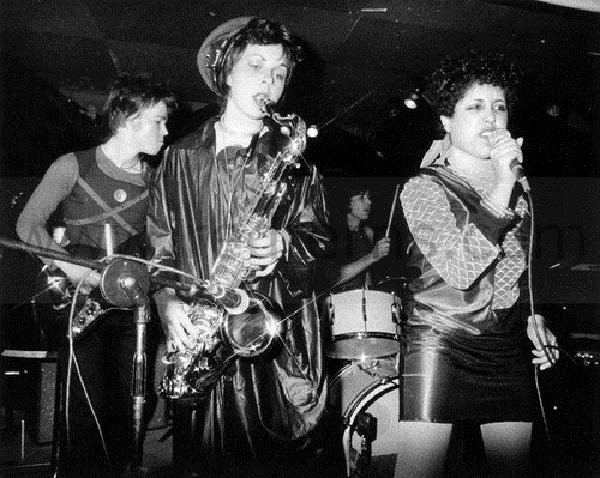
In 1977, the UK punk scene was still dominated by males. Then along came Poly Styrene, one of the first frontwomen in punk history and certainly one of the most unique. She performed wearing a weird dayglo wardrobe and large dental braces, presenting herself as pretty much the opposite of whatever a female sex symbol should be. She also had a huge voice that she puts to good use on their first single, “Oh Bondage Up Yours!” With its iconic opening lines (“some people think little girls should be seen and not heard”) and 16 year old Lora Logic’s saxophone playing, it’s a fiery and quirky punk song that is a clear precursor to pretty much any female punk band that came after. Styrene passed away in April, but her influence on this little segment of music will be felt forever.
7. The Breeders – “Cannonball” (1993)
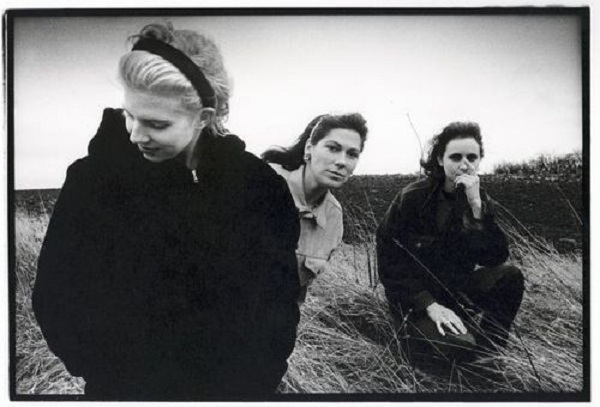
I’d like to just list the parts of “Cannonball” that get stuck in my head on a regular basis: the “OOOO-oooo” thing at the beginning. The bouncing bass line. The surf-poppy guitar part. The verses. The chorus. Free from the evil male tyranny of Black Francis, Kim Deal let it all loose on “Cannonball”, throwing as many hooks at the wall as she could and hoping that they’d stick. Of course, they all do, and as a result it’s one of the catchiest and most infectious songs ever. “Cannonball” may not be a feminist anthem — in fact, I have no idea what the song is even about — but you’d be hard pressed to find a song with so many ideas that are all executed so well. They don’t make them like this anymore.
6. Jefferson Airplane – “White Rabbit” (1967)
“White Rabbit” is a revolutionary song on multiple levels: it’s a pioneering psychedelic song and one of the first examples of not-so-subtly disguised drug references making it onto the radio. I would also argue that “White Rabbit” is the first truly great female rock song, and, sure enough, it is the oldest one on this list. The “Alice in Wonderland” inspired lyrics are clever if nothing else, and point out a valid hypocrisy among parents who forbid drug use but then read a book like that to their children. But I mostly enjoy the trippy instrumentation, the way the song grows over its entire two and a half minutes, and the truly virtuosic vocal performance by Grace Slick.
5. Sonic Youth – “Kool Thing” (1990)
“Kool Thing” apparently began as an excuse to trash LL Cool J in song form, but it ended up becoming something bigger: a bold feminist statement from one of the most respected rock bands in the world as their first major label single. Kim Gordon’s song is full of feminist punk attitude, and it’s a vicious takedown of the misogynistic rap culture (which would only get worse with time) thanks to a hilarious performance by guest vocalist Chuck D. of Public Enemy (“tell it like it is!” “word up!” “hit ’em where it hurts!”). It helps that the song also rocks like a beast, thanks to the signature noise created by guitarists Thurston Moore and Lee Ranaldo. In a long and extremely prolific career, “Kool Thing” stands out as one of Sonic Youth’s best moments and a hugely important piece of girl rock.
4. PJ Harvey – “Sheela-Na-Gig” (1992)
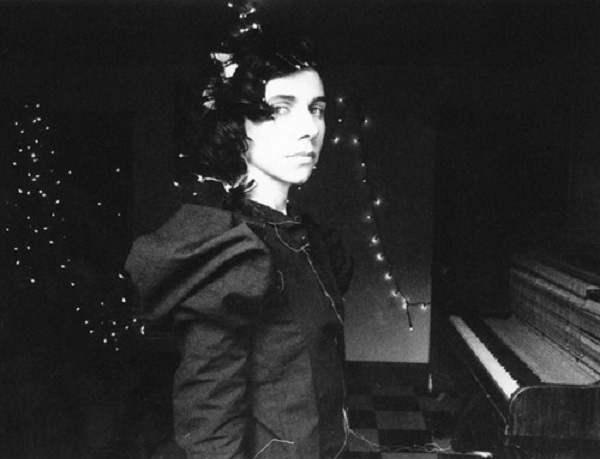
22 year old singer/songwriter/genius PJ Harvey arrived fully formed in 1992 with her debut album “Dry” and its best song “Sheela-Na-Gig.” An unassuming farm girl from England, PJ was nonetheless armed with many musical weapons: a massive voice despite her tiny frame, a complete absence of fear when it came to writing lyrics, and a deep love of blues music and rock. She deploys all of them on “Sheela-Na-Gig”, an astonishing song about a woman whose body is rejected by her man (Wikipedia Sheela-Na-Gig for more information on what she’s talking about). The punk/blues/grunge sound of PJ’s early work combined with those lyrics makes “Sheela-Na-Gig” raw, intense, and a little bit discomforting. In other words, exactly what rock music should be. “Sheela-Na-Gig” is the first moment of genius in PJ Harvey’s career and one of the songs that helps cement her status as the boldest, and, for lack of a better term, ballsiest female artist of all time.
3. Bikini Kill – “Rebel Girl” (1993)
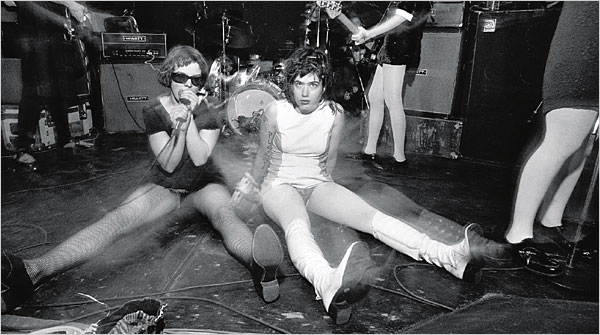
What does a revolution sound like? I don’t know, but “Rebel Girl”, with its military-style drum beat, Kathleen Hanna’s fiery vocals, and that sing-along chorus has to be pretty close. Widely acknowledged as pioneers of the Riot Grrrl movement, Bikini Kill gained media notoriety for their radical feminist music and, ironically, for their decision to shun the mainstream media. While I find the actual Riot Grrrl music to be hit-or-miss a lot of the time, “Rebel Girl” stands out as not only the best crafted song of the movement, but also the one that most perfectly captures what it’s all about. Riot Grrrl was frequently pigeonholed as music that was only about tearing down men (and certainly some of it was), but “Rebel Girl” is all about the positive things that women should be doing: holding their head up high and generally ignoring what other people said about them. Bikini Kill were known for their righteous fury, but “Rebel Girl” sounds like a celebration of everything that Riot Grrrl achieved.
2. Sleater-Kinney – “Dig Me Out” (1997)
By 1997, the Riot Grrrl movement was over and the state of girl rock was in disarray. It took Sleater-Kinney roughly six seconds of their third album “Dig Me Out” to establish themselves as the new torchbearers of girl rock, and as simply one of the best bands in the world. That’s the time it takes for Carrie Brownstein’s memorable guitar riff to play through one time and for new drummer Janet Weiss’ crashing drums to come thundering in. Then comes Corin Tucker’s monstrous firecracker of a voice, an unhinged wail that is able to make even the most basic lyrics sound like a deeply meaningful statement. “Dig Me Out” has a seemingly unsustainable amount of visceral intensity and passion, but Sleater-Kinney keep it going for the rest of that classic album and then for four more after that. In the process, they made it look like their male indie rock counterparts weren’t even trying. “Dig Me Out” is a massive song by not just the best girl band ever, but one of the best bands ever, period.
1. Patti Smith – “Gloria” (1975)
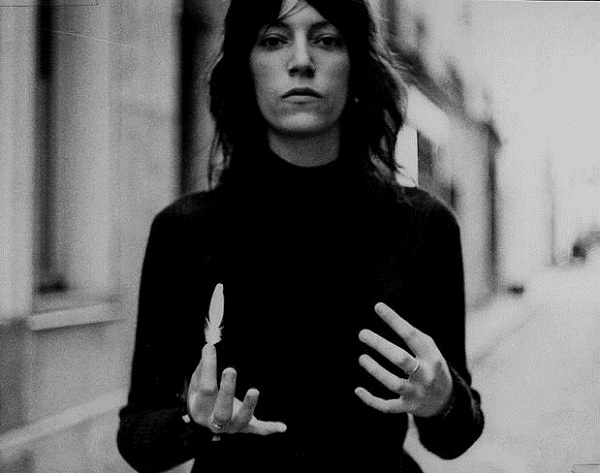
Patti Smith wanted to turn rock music upside down on her debut album “Horses.” On the opening song she pretty much does that literally, borrowing the chorus of a classic horndog male rock song and subverting it into an intellectual feminist statement that absolutely shatters any gender barrier that had previously existed in rock. The reason “Gloria” is number one is simple: outside of Jefferson Airplane, it would not be a stretch to say that every single song on this list is indebted to Patti Smith, and this song in particular. It has possibly the most iconic opening lines in rock music history (“Jesus died for somebody’s sins, but not mine”), a groundbreaking structure, and Patti Smith’s voice, which sounds like no other female singer before it. “Gloria” marks a turning point in music, where women could not only rock, but do it on an intellectual level instead of one completely based on sex appeal or appealing to the lowest common denominator.





 The Noise Made By People