Confessions of a Bon Iver Hater

The old cliché about music is that it brings people together. It’s a unifying force in our lives, something we can often discuss with people we have little else in common with. However, I sometimes find that music is just the opposite for me. A lot of the time, music is alienating: It’s the band you love that nobody else seems to know or the band you hate that everyone else seems to love. Both seem to happen to me all the time.

In 2011, no artist represented that idea more than Bon Iver. The band, led by Eau Claire native Justin Vernon, released their self-titled second album this year to rave reviews from the music press and fans, topping many year end music lists in the process. He was the subject of countless magazine covers and articles, Facebook posts, and was even nominated for the Grammy for best album, signifying his breakthrough into the mainstream consciousness. Living in St. Paul, which is right in the heart of Vernon’s midwest stomping grounds, it seems like everyone loves Bon Iver.

Except for me, of course. In the months since his last album came out, I’ve been carrying around a horrible secret:  I kind of hate Bon Iver. I haven’t told anyone because I’ve been afraid of possible retribution (Bon Iver’s fans are an intimidating bunch) and, in general, it’s hard to tell someone that you think one of their favorite artists sucks. Especially when it seems to be the favorite artist of  half the campus where you spend most of your time.

It wasn’t always this way. Bon Iver’s first album, 2008’s For Emma, Forever Ago wasn’t my cup of tea, but I at least respected what went into it. The story of Vernon secluding into a cabin after having his heart broken and just writing music in isolation appealed to me, even if it was a tad corny. I didn’t like it, but I saw the appeal because it came from such an honest, genuine place.

I can’t say the same for his self-titled second album, which has baffled and frustrated me pretty much all year. It’s a long way from the spare, “cabin” arrangements of his first album, instead opting to bury his voice under layers and layers of glossy 80’s style sheen. For the most part, you can barely understand what Vernon is singing about through the album. This works for me if you’re a musical genius like Kevin Shields or Radiohead; it doesn’t when your album sounds like it was produced on a synthesizer made in 1983.

Most of all though, though, Bon Iver is just so… dull. Nothing about it grabs my attention. This is incredibly subjective, of course, because different things are interesting to different people. But I have an incredibly hard time picturing anyone getting pumped up to listen to Bon Iver. The same could be said about a lot of folk music, but at least most folk singers have concrete lyrics that I can grab on to so there’s an actual meaning to their songs. Any emotional connection I could make to Bon Iver was typically buried under a synthesizer, a guitar, a saxophone solo, autotune, and the washed-out production.

It’s rare that I outright dislike an album that is so widely acclaimed, so I thought a lot this year about why I had such an intensely negative reaction to Bon Iver. For awhile, I looked at it as sort of a character flaw. Maybe I’m just biased against Vernon and his bearded white male folky brethren, or just wanted to hate the album because it was popular. Perhaps I’m just too stupid to understand the album’s complexity, similar to how I don’t get Animal Collective.

These are all still valid possibilities, but I also think Bon Iver just lacks pretty much everything I look for in music. To illustrate this point, and to try to figure out why I hated this damn album so much, I thought it would be interesting to compare it to my favorite albums of this year.

At the very top is PJ Harvey’s Let England Shake, which is probably the most sensible comparison to Bon Iver. These are the two most acclaimed albums of the year and both are primarily folk-influenced. Both have been called boring by a lot of people, yet I found Let England Shake incredibly powerful and moving while finding Bon Iver tedious. It’s really in the conception where PJ blows Bon Iver out of the water: She made a searing portrait of war in her homeland.  Bon Iver made… what exactly? Another folk album where a white guy sings about how sad he is?  Where Bon Iver’s lyrics were either cliche or impossible to understand, PJ’s grabbed me and jolted me and had a visceral impact. Let England Shake was my favorite album this year because of its ambition and literary depth.  Bon Iver had neither of those things.

That might have been an unfair comparison, since Let England Shake is an amazing album by one of my favorite artists. Perhaps a more fair comparison would be EMA, whose debut album Past Life Martyred Saints was third on my list and was also somewhat folk-influenced. I don’t think any song this year jolted me and made me say “who the hell is this?” the way EMA’s “California” did when I first heard it. It was raw, bold, and confrontational, lyrically and musically. It pulled no punches, which is something I really love in music.

Bon Iver is a far cry from that idea. To say Bon Iver pulls punches would be an understatement. It doesn’t even punch at all. It just kind of sits there. There is no attempt at standing out, no hint of challenging listeners, none of the sense of emotional catharsis that I thought Past Life Martyred Saints had. It has absolutely no boldness or originality. It’s just another in a long line of indie folk albums, the type that we hear seemingly thousands of every single year.

In the end, I’m left wondering what it says about the state of indie music today that something like Bon Iver is so widely adored. Is this really what we want from music? Is this what we’re willing to accept from artists? I don’t doubt that for many people the album had a profound emotional impact. Personally, I expect more. I want music that challenges me, excites me, is bold and original. In other words, I don’t want Bon Iver.
Favorite Albums of 2011

At this point, most sites and magazines are releasing their 2011 music lists (even though there’s still some time left) so I figured I’d join in the party.  Rather than over-analyze which albums are “important” my list is basically the albums I listened to the most and felt the strongest about.  I think, based on previous posts, the stuff I like is pretty clear.  First and foremost, I enjoy albums that at least try to accomplish something unique and have some sort of ambition, and I felt like 2011 had a good supply of those.

The list, unsurprisingly, is also quite female-heavy.  Admittedly, this is largely due to my bias towards female singers and those are the types of artists seek out and listen to the most. But let it be known that I did listen to many of the acclaimed albums released by male singers, and I found most of them oppressively dull.  The shift in the last few years away from guitar rock and into folk, bedroom pop, and other genres largely populated by bearded wan guys has done nothing but reinforce my female-biased perspective.

So, in 2011 particularly, I felt that female artists gave music something it was missing in most aspects.  If you have a problem with it, make your own list, or just yell at me in the comments or on Facebook.  I’ll be happy to argue with you.

10. Eleanor Friedberger – Last Summer

I don’t think any album this year was as pleasant of a surprise to me as Last Summer, the solo debut of the Fiery Furnaces’ Eleanor Friedberger.  I’ve only been a casual fan of the Furnaces (particularly their zany 2004 epic Blueberry Boat), but at times their overstuffed, wildly imaginative music could become frustrating to listen to.  Last Summer solves most of those flaws, building songs around simple instrumental configurations, with an emphasis on bass, piano, and occasionally saxophone.  What really elevates the album beyond the typical indie pop fare is Friedberger’s idiosyncratic charm as a vocalist and lyricist, which helps it strike the perfect balance between accessibility and experimentation.  High points like “My Mistakes” and “Roosevelt Island” are beautiful, nostalgic pieces of summery pop and prove that Eleanor is capable of succeeding just fine without her brother.

9. Radiohead – The King of Limbs

It’s a good thing Radiohead released The King of Limbs in February.  After purchasing it in advance with massive expectations, I was incredibly let down by my first two listens and frustrated by the lack of guitar, the mere eight songs, and its general obliqueness.  Of course, like most Radiohead albums, King of Limbs is a grower, and after revisiting it a few months later I began to appreciate the underrated rhythm section’s contributions to the album, plus the back half which has some of the band’s most beautiful work to date like “Codex” and “Give up the Ghost.”  While The King of Limbs may not be an essential, ambitious Radiohead album like Kid A or OK Computer, it’s still a Radiohead album, and it shows the band settling into a comfortable groove rather than trying to change the world.

8. Widowspeak – Widowspeak

First thing’s first: Yes, Widowspeak singer Molly Hamilton sounds a lot like Mazzy Star’s Hope Sandoval.  Despite that obvious influence, the band is able to bring something unique to the table, combining Mazzy Star’s hazy aesthetic with the sounds of Ennio Morricone’s spaghetti western soundtracks.  What’s most impressive is how well-crafted and self-assured the band’s songs are on their debut album, full of catchy melodies and memorable guitar riffs like on the knockout track “Gun Shy.”  Widowspeak is nothing groundbreaking, but it’s one of the most fully-formed albums of the year and one that I found myself listening to repeatedly.

7. Yuck – Yuck

Much like Widowspeak, Yuck has obvious 90’s influences: Dinosaur Jr., Sonic Youth, and My Bloody Valentine among them.  Those are some of my favorite bands, so the group of age 20ish youngsters had big shoes to fill, and for the first couple listens I couldn’t help but be annoyed as they pillaged basically every element from those bands in creating their sound. What separates Yuck from the rest of the bands that knock off these indie rock heroes is that their music never feels cynical or calculated.  Rather, it’s the sound of young people playing the kind of music they like to listen to (and doing it quite well to boot, such as on noisy, melodic guitar tracks like “Get Away” and “Holing Out” and the sweet male/female “Georgia”). Besides, is sounding kind of like Dinosaur Jr. and Sonic Youth really a bad thing?

6. Fucked Up – David Comes to Life

This is another album I wasn’t expecting to like, probably because of the silly band name and the lead singer’s growling, roaring vocals. Most of the time I’d lament what could have been had the band picked a cool female singer instead of a questionably talented guy, but it’s hard to imagine another singer capturing Fucked Up’s anarchic spirit.  David Comes to Life is an 18 track, 77 minute rock opera, clearly indebted to the ambitious punk albums of bands like Husker Du.  Like most concept albums, the storyline isn’t anything special and the album is fairly monochromatic and arguably about 25 minutes too long, but it’s also full of some of the most exciting rock music of the year with one fist-pumping anthem after another and many layers of arena-ready guitar.  David Comes to Life filled a void for me in 2011 as an ambitious, epic rock album.

5. Björk – Biophilia

In typical Björk fashion, most of the build-up to Biophilia focused on everything but the music. People talked about the made-up instruments, the iPad apps, and all of its other multimedia connections.  Perhaps that’s why critics were surprised at Biophilia‘s sparse sonic landscapes and immediately complained about the lack of “songs” on the album.  (Could there be a lazier criticism of music?)  In the end, it seems like critics didn’t really grasp what Björk was doing: For example, many complained that a song called “Dark Matter” was too formless and lacked pop hooks (see what she did there?). Every song on Biophilia  ties into science and nature in a clever, uniquely Björky way, like the quirky love song “Virus” which compares lovers to being a “host”  or “Mutual Core” which begins contemplatively before exploding into noise and beats.  Biophilia is unlikely to convert any non-believers, but it’s a completely unique album full of wonder and awe at the natural world.  And there’s songs too, if you give it some time.

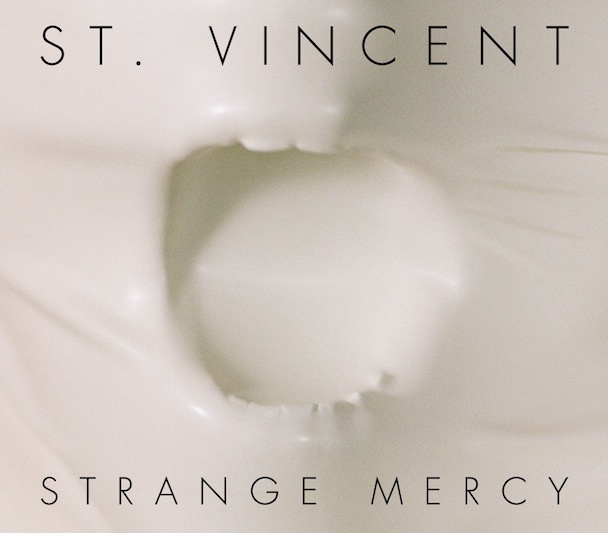
4. St. Vincent – Strange Mercy

Fully entrenched in her status as an indie goddess, Annie Clark easily could have settled into a zone and kept making quirky, whimsical pop songs like on her second album Actor. Fortunately she didn’t, and Strange Mercy represents a quantum leap forward for her as an artist.  Her music retains its quirks and charms, but Strange Mercy is more aggressive and strange than any of her previous work, from the ominous “Surgeon” to the creepy-but-catchy “Cruel” (with its disturbingly funny music video).  It also has some of her most personal songs (particularly “Cheerleader”) and she allows her guitar skills to be at the forefront far more than she has previously.  Strange Mercy is another step forward for St. Vincent, who has staked a claim as one of the most unique and interesting artists in music today.

3. EMA – Past Life Martyred Saints

Erika M. Anderson, formerly of Gowns, put a lifetime’s worth of pain and anguish into her debut solo album Past Life Martyred Saints, and we’re all better off for it.  EMA not only establishes herself as a fearless singer-songwriter on Past Life Martyred Saints, but also a unique one, as she channels her emotions into a pair of epic folk-noise suites (“The Grey Ship” and “Red Star”) which bookend the album.  In the middle is some of the most cathartic, raw music of 2011, including the apocalyptic, Kim Gordon-meets-Patti Smith tale of alienation “California” and the horrifying “Butterfly Knife” which is about body mutilation.  All of it is held together by EMA’s strong, versatile singing voice and guitar playing.  Past Life Martyred Saints might be too much gloom for some people to take, but for me it was one of the most powerful albums of 2011 and an astonishing debut.

2. Wild Flag – Wild Flag

All-female supergroup Wild Flag were burdened with massive expectations for their debut album. The band, consisting of Janet Weiss and Carrie Brownstein of Sleater-Kinney, Mary Timony of Helium, and Rebecca Cole of The Minders were simultaneously supposed to be saviors for women in rock and appeal to die-hard Sleater-Kinney fans who had waited for 6 years since their final album The Woods.  While saving rock music may be a stretch, Wild Flag is able to move beyond the supergroup label and sound like a legitimate band, one with skilled members who know their way around a great rock song.  More than anything else, Wild Flag is just plain fun, which can be refreshing in this era of self-serious navel-gazing.  And with songs like “Romance” the band celebrates the joy of rock music while simultaneously sharing it with starving Sleater-Kinney fans.

1. PJ Harvey – Let England Shake

There’s not much left for me to say about PJ Harvey at this point.  Her 10th album marked yet another departure in a career that has been full of them, presenting a study of her homeland of England and how it has been affected by war through time.  Let England Shake unfolds like a great World War I memoir as Harvey acts as a narrator through some of the country’s greatest atrocities, singing about the inevitable sense of war with a grim sense of resignation rather than shrill protests.  In many ways, Let England Shake is a culmination of PJ Harvey’s 20 year career:  It has the visceral, occasionally gory lyrics of Rid of Me, the higher-register singing of White Chalk, and the beauty and sense of place of Stories from the City, Stories from the Sea.  While this version of PJ Harvey may be quieter, her songs still hit with incredible weight emotionally, and it’s arguably her best work lyrically (I got chills reading the lyrics after I bought my copy of it).  Let England Shake is catchy, horrifying, and beautiful, often at the same time, and it stands tall above any other album this year for me.  It’s my favorite album of this year, the last few years, and probably the next few.

St. Vincent – “Strange Mercy”

One of my favorite things in music is to hear a talented artist that finally puts the pieces together and begins to live up to their potential. On her forthcoming album “Strange Mercy”, which is currently streaming on NPR, Annie Clark (aka St. Vincent) does just that, and in the process asserts herself as one of the top artists in music today.

Clark’s 2009 album, “Actor”, was one of my favorites of the last few years, and it established Clark as a unique voice and talent.  Yet, it was abundantly clear that the artist behind it was capable of doing a lot better.  For one thing, despite proving on stage that she is a tremendous guitar player, “Actor” was curiously devoid of many great guitar songs, with Clark instead focusing on disney-type strings that were only occasionally punctuated by noisy guitar blasts.  The songs were well crafted and enjoyable, but also frustratingly coy and conventional for someone that could be capable of rocking souls.

My desire for St. Vincent to embrace her inner rock goddess only intensified a few weeks ago, when she did an earsplitting cover of Big Black’s “Kerosene” at the This Band Could Be Your Life show at the Bowery Ballroom.  Rather than do a quirky, “unique” cover of the song, Clark instead opted to embrace Big Black singer Steve Albini’s misanthropic rage, and, while some may think it came off as phony, I thought she did a pretty admirable job on a song that seems really difficult to truly replicate.  It was the exact kind of thing I had been hoping to hear on “Strange Mercy.”

I am happy to report, then, that “Strange Mercy” fulfills what I wanted it to be, and I think it’s one of the best albums of the year.  In every way, I think it’s a quantum leap over “Actor” (which, again, I liked a lot).  Clark’s voice continues to develop, as she’s able to convey more emotion and sound less detached from her dense arrangements.  The lyrics are better too — still sinister like they were on “Actor”, but decidedly more personal.

Most of all though, “Strange Mercy” is weirder than “Actor”, and it’s much better off for it.  Clark continues to use strings, but rather than be the focus, they’re more of a complement to her guitar playing, which finally begins to shine on this album.  There’s funk undercurrents, like the synth solo at the end of “Surgeon”, which is one of the album’s surreal highlights.  All of the bizarre touches on “Actor” are ramped up here, and while it may drive some listeners that appreciated her poppy side (like on her first album “Marry Me”) away, I think it makes her music far more compelling.

Not that “Strange Mercy” doesn’t have its pop moments.  Lead single “Cruel” is one of the best songs of the year so far, and it showcases Clark’s unique ability to turn all of the sounds and influences into an accessible rock song.  While there are layers of strings and woodwinds, Clark’s guitar shines through with the repeated twangy riff and a couple solos in the middle and end.  It’s also one of the best music videos I’ve seen in a long time, as Clark gets literally buried by all of her domestic duties after getting kidnapped by her family.

On “Cheerleader”, maybe the most personal song Clark has ever written, she sings “I don’t want to be a cheerleader no more.”  That chorus, which explodes after the more delicate verses, is one of the best moments on the album, and in a truly hacky piece of music criticism, I decided that this was more than just a song about trying to stop being a pushover:  It was Clark rejecting the idea of being an indie pop princess.  Many had pegged “Strange Mercy” as a commercial breakthrough for her — and it still very well could be — but I think this music is far too weird, psychedelic, and sinister to be showing up the next iPod commercial.

My other favorite song is probably “Northern Lights”, which is the guitar song I’ve been waiting for from St. Vincent.  It’s pretty much pure noisy rock more in the vein of the Pixies or Breeders, with some roaring guitar solos and a constant build up to the end.  I think Clark could still use to sing more forcefully at times, and this one of the moments on the album where she approaches that idea more, particularly towards the end when she begins to sound more hysterical.

As good as “Strange Mercy” is, I think there’s still room for improvement for St. Vincent.  But this album proves that she’s someone who is going to follow her own muse and evolve musically, which is the most important thing to me.   Her ability to put that ambition into well crafted rock songs is a large part of what makes “Strange Mercy” one of the best, most exciting records of 2011 in my book.