Sleater-Kinney – “No Cities to Love”

About 3-4 years ago, I absolutely worshiped Sleater-Kinney. I listened to all of their albums a million times, wrote about them here a bunch, and just generally would gush about them to anyone that listened. Unfortunately, I was late to the scene (as usual) and never got to experience them as an active band. This led to me developing a sad ritual where I would frequently google “Sleater-Kinney” and hope for some news, any news, that indicated they’d be reuniting. At some point, I stopped googling, stopped being hopeful for a reunion, and pretty much stopped listening to the band altogether — not because I suddenly hated them, but because it felt like there was nothing new to discover in their music. I didn’t need Sleater-Kinney anymore.

Of course, then they actually did reunite last year, and I had some mixed feelings. Most of these had to do with guitarist/singer Carrie Brownstein, who has ascended to some level of celebrity in the last few years as a star of the TV series “Portlandia.” She’s stated in interviews that Sleater-Kinney needed to be a full-time thing, and I was worried that it would be treated more like a side project, which doesn’t seem like a context the band can function in.

My other big concern was Sleater-Kinney being the subject of the modern album hype cycle. This is more of a niche thing for people overly plugged into the music press, Twitter, etc, but it’s a phenomenon I really hate, where the lead-up to a band’s album is treated like a coronation that results in a ton of mostly uncritical hyperbole and excitement. This has the unfortunate effect of making any band feel like the music equivalent of the New York Yankees — an overly popular powerhouse team you never stop hearing about, get really sick of before you even see them play, and desperately want to see lose. To me, Sleater-Kinney has always felt like an underdog band of sorts, so seeing them pushed into this Yankees role was pretty lame, and I eventually had to tune it all out as much as I could.

None of this even gets into the actual music, which is the other problem: at the end of their initial run, the band had seemingly pushed themselves as far as they possibly could with The Woods, an album I still love because of its towering ambition and ferocity. Following it up seemed virtually impossible to me, especially after a ten-year layoff, so No Cities to Love had an insurmountable task from the get-go.

A lot of these concerns pretty much stopped mattering once I actually, you know, listened to the damn album. The band hits their groove immediately on “Price Tag,” a fiery working-class anthem, and keeps it going through my favorite track “Fangless” and the roaring “Surface Envy.” The rest of the album doesn’t quite reach the heights of those first three tracks, but there is still a consistency and solidness to No Cities to Love that would be surprising after a ten-year layoff if this wasn’t Sleater-Kinney, a band with incredible chemistry that spent years routinely churning out great music.

My favorite part of No Cities to Love is definitely the re-emergence of Corin Tucker, who still has one of the most essential voices in rock music. I actually liked her albums with The Corin Tucker Band and thought they were generally under-appreciated, but she is really at home fronting this band, and her voice always gives the songs an urgency and jolt they might otherwise not have. On guitar, she also provides more of a low-end on this album than she has before, giving the usually trebly band a more full sound, and her vocal interplay with Brownstein hasn’t missed a beat since The Woods. Meanwhile, Janet Weiss is still a monster on drums, giving the songs a real drive and purpose.

There is a tendency to assume any album made after this big of a layoff needs to be a huge artistic statement, which No Cities to Love avoids — for the most part, it’s just a really good rock album. I find that makes it a bit less compelling than something like The Woods or One Beat, which were more ambitious, exciting albums, but I also don’t really see that as the purpose of No Cities to Love. This is the start of a new era for the band — a reintroduction of sorts — and it shows that they can still make thrilling, smart rock music. And after all my reservations, it convinced me that I do still need Sleater-Kinney after all.
Björk – “Vulnicura”

There’s a simple question I like to ask myself when listening to an album for the first time: “Could someone else have made this?” About 99% of the time, the answer is “yes” — maybe someone else wouldn’t have made literally the same album with all the same choices, but they could have easily approximated it by finding the right influences and adopting a sound that’s been done before. That doesn’t mean it’s bad necessarily, just that it isn’t really breaking new ground (because that’s hard to do), and as a result it’s hard to be blown away by it. The albums that really make me love music are in the 1% “no” category, and have some level of personality or artistry that makes them completely unique.

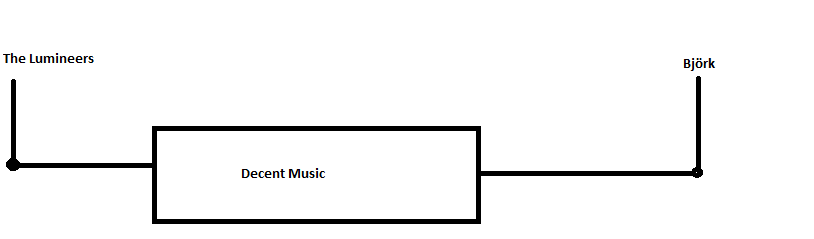
The reason for my well-documented obsession/fascination with Björk is that she scores very highly on this test. Every Björk album sounds unlike anything else ever made, including artists who consciously tried to sound like her. I also enjoy statistical oddities, and I’ve started to think of Björk in these terms — as an artist, she is an outlier. Her combination of creativity and incredible natural vocal ability puts her on a musical island, where there are no real comparisons except to herself, as illustrated by this box-and-whisker plot. (I’m not entirely sure if I did this right because I haven’t taken a math class since high school.)

Bjork box and whisker

Björk’s latest album, Vulnicura, is what she calls a “complete heartbreak album,” and it details the dissolution of her long-time partnership with artist Matthew Barney in chronological order. The first six songs are labeled with a time period relative to the breakup (such as “9 months before”), with the first three taking place before and the next three taking place after. In this great Pitchfork interview, she expressed fear that this concept was too “boring and predictable,” but the simplicity of it ends up being a source of Vulnicura‘s power. In the last few years, Björk has made fascinating conceptual albums — Biophilia was a science-filled ode to the natural world, Medulla an audacious a capella album — that sometimes got a bit too brainy for their own good. Vulnicura‘s story helps it find that crucial heart/brain balance that Björk did better than anyone on her classic albums Post and Homogenic.

The honesty of Vulnicura is what really makes it a stunning listen. It’s not like other music is dishonest necessarily, but this album takes it to a near-uncomfortable level — Björk spares no details, and the subject matter inevitably gets brutally sad as her relationship evaporates. This peaks with “Black Lake,” the 10-minute post-breakup centerpiece of the album, in which she describes her “soul torn apart” and broken spirit. The chronological concept of Vulnicura really pays off, as it makes the album into a story, and the mood of the songs shifts as the relationship progresses. Opening song “Stonemilker” is a majestic, orchestral track that wouldn’t sound out of place on Homogenic, and portrays the first seeds of discontent as she demands “emotional respect.” Things get progressively darker from there, as she tells the story of their last night together, the aftermath of the breakup, and the effect it had on herself and the rest of her family.

All of this sadness, along with the lengthy songs and the fact that it’s Björk, has already led to Vulnicura being branded as one of those ordeal albums that is a chore to listen to. At least part of what makes it so affecting is that Björk has created such a connection with her fans over the years, and I’ve always thought of her music as this Utopian idea that crosses genre, language, and geographical barriers. That makes it difficult to listen to her reach what seems to be a rock-bottom emotionally. That said, I also found myself inspired by the openness of the album, especially given her celebrity stature — this was not an album that she needed to make to prove herself. Rather, it seems like something she just had to make for the sake of emotional catharsis, which Vulnicura certainly provides. On the closing track, “Quicksand,” she states a possible moral of the album: “when we’re broken, we are whole, and when we’re whole, we are broken.”

Vulnicura really reaffirmed what I am always looking for in music. The whole reason I listen to it, talk about it, and write stupid posts about it is for albums like this, that are able to express emotions and make you feel things in a way that other media simply couldn’t. It’s an album for people who still want music that has intellectual and emotional depth, that challenges you, demands your attention, and makes you think. And there is only one person who could have made it. Vulnicura may be bleak and difficult, but it is also a triumph.

Algebra Suicide

With so much music writing on the internet now, it has become harder for me to discover bands that really get me excited. Most of the new bands have already been written about endlessly by a million different websites, which makes it impossible for me to build an authentic connection to the music. And the older bands that are deemed “important” and fit into established music narratives are often mythologized in a way that instantly turns me off from them, because I hate it when people tell me what I should like and how I should perceive something before I even get a chance to experience it myself. The sweet spot, I’ve found, is the older bands that aren’t really talked about anymore, usually because they don’t quite fit into a convenient narrative about the era they performed in and/or didn’t have the level of acclaim to be considered Important Music. The reasons these bands aren’t considered important are why I end up liking them so much: they’re not being cited as an influence and emulated endlessly by people today, which often means they made weird, less mainstream music in a style that hasn’t been diluted (yet) by the works of other inferior bands.

One of these bands that I’ve been into lately since randomly hearing them on a radio show is Algebra Suicide, a husband/wife duo of Don Hedeker and Lydia Tomkiw. They performed from the late 80s-mid 90s and built a small following before the couple got divorced in 1993 and the band broke up in 1995. It doesn’t sound like they ever made much money or got much critical acclaim, but I think their music is really cool, and it conveniently has a couple traits that I’ve been obsessed with lately. The biggest one is that the band doesn’t have a traditional singer — instead, Tomkiw reads her poetry over Hedeker’s guitar riffs and a drum machine.

This talking instead of straight-up singing thing has been an ongoing fascination for me — two of my favorite songs last year, Courtney Barnett’s “Avant Gardener” and Magik Markers’ “American Sphinx Face” had this kind of style, and a lot of my older artists I enjoy like Life Without Buildings, The Fall, Patti Smith, and Laurie Anderson (who is the most obvious and frequent comparison to Algebra Suicide) can be grouped into the talk-singing “genre.” I think a lot of the appeal for me is that there’s something inherently daring about talking instead of singing. The lyrics and emotion of the vocalist can’t hide behind a catchy melody or impressive vocal acrobatics — in every Algebra Suicide song, Tomkiw is basically talking directly to the listener, daring them to form an opinion on her.

In the absence of traditional singing, talk-singers need to find other ways to express emotion and character, either through their words or the way they say their words. Some of them, like Sue Tompkins and Mark E. Smith, have a ton of energy and cram in as many words as possible, which suits their more free-wheeling, rambling lyrical styles. Tomkiw falls on the opposite end of that spectrum: her delivery is very deadpan, almost lethargic, and her poetry isn’t particularly wordy, instead relying on short, clipped phrasing and a thick Midwestern accent that adds a lot of color to her lyrics. Hedeker backs that up with a similarly simple approach, matching her words with repetitious guitar parts and drum machine beats. Algebra Suicide follows this formula on every song in the absence of traditional verses, choruses, or hooks.

The danger of this kind of band is that their songs could all start to sound alike and blur together when you listen to an album of them. Algebra Suicide avoids this mostly due to Tomkiw’s skill as a poet. I find there to be a very noticeable difference between a poet who is singing and a singer who thinks they’re a poet, and Tomkiw is definitely in the former category. Her lyrics are a significant cut above typical pop music lyrics that always make me think the band was just sitting around with a rhyming dictionary, trying to get the whole writing process over with. A good example is my favorite song by the band, “Heat Wave,” which has really vivid imagery describing a hot boring day in the city.

Algebra Suicide released a handful of albums, though I’ve found most of them impossible to find. Miraculously, “The Secret Like Crazy,” a 1988 compilation of their early singles and other unreleased songs, is available on streaming services. It contains their most well-known songs and worked well for me as an introduction to the band’s style. I also found a blog that compiled all of Lydia Tomkiw’s lyrics, which is a really useful resource that also doubles as a book of excellent poetry.